Urban Growth Strategies

Share Urban Growth Strategies on Facebook Share Urban Growth Strategies on X (formerly Twitter) Share Urban Growth Strategies on Linkedin Email Urban Growth Strategies link

Urban Growth Strategies will identify the tools, actions, policies, and land needed for the next 20 years to support housing and living wage jobs in Eugene.

Our homes are the foundations for our lives; they are places of shelter, safety, gathering and comfort. Finding a place to call home and earning enough to pay for rent or a mortgage is getting harder in Eugene. Our community is growing, and the City is working hard to improve opportunities for housing and jobs in Eugene.

Project Background

Building off years of planning and community engagement through Envision Eugene, the project will evaluate the need for housing, jobs, parks, infrastructure, schools, and other urban land uses, as well as what tools can help Eugene to grow more efficiently. This work will result in studies of what land is available in Eugene, updates to the Envision Eugene Comprehensive Plan, other adopted City plans and land use regulations, a parcel-specific land use designation map, and an evaluation of whether there is a need to expand the urban growth boundary (UGB).

Urban Growth Strategies is a collaborative effort that integrates state-required urban growth planning, equitable community engagement, and City Council-directed policy work.

Project Phases

Urban Growth Strategies includes four key phases:

  • Understand the needs and priorities of community members related to housing, jobs, and access to community assets in Eugene.
  • Take actions to address identified needs, especially related to housing production, affordability, and choice.
  • Study the land needed for jobs, housing, and other urban uses (such as parks, schools, and infrastructure).
  • Integrate the results of community engagement and technical analysis to create and update the policies and maps guiding land use planning in Eugene.

Stay Involved

Stay tuned for opportunities to engage in Urban Growth Strategies. In the meantime, use the tool below to “Ask a Question" and check out project updates as they're available.

Urban Growth Strategies will identify the tools, actions, policies, and land needed for the next 20 years to support housing and living wage jobs in Eugene.

Our homes are the foundations for our lives; they are places of shelter, safety, gathering and comfort. Finding a place to call home and earning enough to pay for rent or a mortgage is getting harder in Eugene. Our community is growing, and the City is working hard to improve opportunities for housing and jobs in Eugene.

Project Background

Building off years of planning and community engagement through Envision Eugene, the project will evaluate the need for housing, jobs, parks, infrastructure, schools, and other urban land uses, as well as what tools can help Eugene to grow more efficiently. This work will result in studies of what land is available in Eugene, updates to the Envision Eugene Comprehensive Plan, other adopted City plans and land use regulations, a parcel-specific land use designation map, and an evaluation of whether there is a need to expand the urban growth boundary (UGB).

Urban Growth Strategies is a collaborative effort that integrates state-required urban growth planning, equitable community engagement, and City Council-directed policy work.

Project Phases

Urban Growth Strategies includes four key phases:

  • Understand the needs and priorities of community members related to housing, jobs, and access to community assets in Eugene.
  • Take actions to address identified needs, especially related to housing production, affordability, and choice.
  • Study the land needed for jobs, housing, and other urban uses (such as parks, schools, and infrastructure).
  • Integrate the results of community engagement and technical analysis to create and update the policies and maps guiding land use planning in Eugene.

Stay Involved

Stay tuned for opportunities to engage in Urban Growth Strategies. In the meantime, use the tool below to “Ask a Question" and check out project updates as they're available.

  • Urban Growth Strategies Adoption Package #1

    Share Urban Growth Strategies Adoption Package #1 on Facebook Share Urban Growth Strategies Adoption Package #1 on X (formerly Twitter) Share Urban Growth Strategies Adoption Package #1 on Linkedin Email Urban Growth Strategies Adoption Package #1 link

    Planning Commission Recommendation

    On July 14, 2026, and July 28, 2026, the Eugene Planning Commission deliberated on Urban Growth Strategies Adoption Package #1 following the public hearing held on June 23, 2026. Commissioners discussed the proposed amendments related to middle housing, micro village and single room occupancies, day care centers, residential treatment facilities, expedited land use applications, land use approval extensions, and an increase to the R-1 Low-Density Residential Zone allowed building height.

    The Commission recommended a package of code amendments to the Eugene City Council, including staff proposed changes responding to public testimony and Commission discussion, as well as an increase to the building height in R-1. The City Council process will take place in Fall 2026, including a work session, public hearing, and deliberations, with action expected before the end of the year.

    Proposed Changes

    This summary of proposed citywide land use regulation amendments (pdf) highlights the changes intended to remove barriers and expand access to housing and jobs, including:

    • Creating new development standards for single room occupancies (SRO) and micro village housing (pdf), two housing types allowing very small units with shared community facilities. Both housing types are proposed to be allowed in all residential and commercial zones, as well as special area zones that allow housing. The proposed standards respond to recent changes in state law to reduce barriers to the development of SROs.
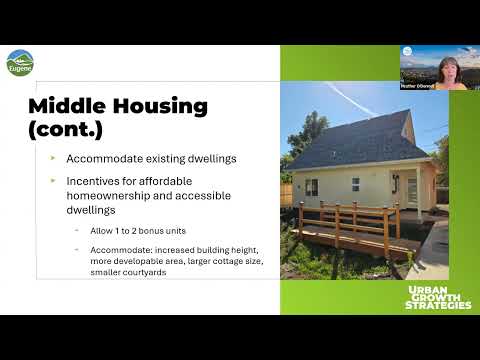
    • Updates to middle housing development and land division standards (pdf), including changes to reduce the cost and complexity to develop middle housing, improve clarity during plan review, comply with recent changes to state law, and align with state model housing codes.
    • Increasing the maximum building height in the (R-1) Low-Density Residential Zone from 30 to 35 feet to improve building costs and add flexibility by allowing a full three stories of living area.
    • Allowing residential treatment facilities, residential treatment homes, and similar uses as allowed uses in more zones in alignment with recent changes in state law.
    • Allowing adult and child day care centers and day care homes as permitted uses (outright or with certain restrictions) in more zones. The proposed amendments related to child day care respond to recent changes in state law to reduce barriers to child care.
    • Streamlining some residential land use application processes to comply with state law and make development more efficient, by adding a new expedited application process for zone changes to a higher residential density, residential planned unit developments, and variances from a residential standard.
    • Allowing three-year extensions of the expiration date for certain land use approvals. The three-year extension is proposed in response to the housing crisis and to remove barriers to housing and job development.

    Review the initial draft proposed code amendments:

    Staff are proposing three adoption packages in 2026 and 2027 and will ask the Eugene and Lane County Planning Commissions to hold a public hearing for the second adoption package in the fall of 2026. A summary of all housing and jobs actions (including actions proposed for adoption both in 2026 and 2027) is available here (pdf).

    Public Meetings and Testimony

    As a part of the Urban Growth Strategies Adoption Package #1, both the Eugene Planning Commission and the Eugene City Council will hold work sessions, public hearings, and deliberations. The City Council will be the final local decision-maker. Written and emailed testimony will be provided to decision makers in batches as it is received.

    Work Session: Eugene City Council

    On September 16, 2026, Eugene City Council will hold a work session to discuss proposed Urban Growth Strategies Adoption Package 1#. More information for options to attend, or watch the work session will be available on the City's public meetings page.

    Interested in more detail about the adoption package and process? Learn more in the summary of proposed citywide land use regulation amendments (pdf). The public hearing materials, including the official proposed amendments, are available here.

    How to Submit Testimony:

    • Submit e-mail testimony to  UGS@eugene-or.gov
    • Submit a written statement to the Planning Commission, c/o Elena Domingo, City of Eugene Planning Division, 99 W. 10th Avenue, Eugene, Oregon 97401

    UGS Adoption Package #1 Testimony

    Submitted testimony will be posted here in batches after it is forwarded to decision makers:

    *An index and information for each batch of testimony is included as the first section of each batch. This is the testimony submitted and included in the record.

    Planning Commission Recommendation

    On July 14, 2026, and July 28, 2026, the Eugene Planning Commission deliberated on Urban Growth Strategies Adoption Package #1 following the public hearing held on June 23, 2026. Commissioners discussed the proposed amendments related to middle housing, micro village and single room occupancies, day care centers, residential treatment facilities, expedited land use applications, land use approval extensions, and an increase to the R-1 Low-Density Residential Zone allowed building height.

    The Commission recommended a package of code amendments to the Eugene City Council, including staff proposed changes responding to public testimony and Commission discussion, as well as an increase to the building height in R-1. The City Council process will take place in Fall 2026, including a work session, public hearing, and deliberations, with action expected before the end of the year.

    Proposed Changes

    This summary of proposed citywide land use regulation amendments (pdf) highlights the changes intended to remove barriers and expand access to housing and jobs, including:

    • Creating new development standards for single room occupancies (SRO) and micro village housing (pdf), two housing types allowing very small units with shared community facilities. Both housing types are proposed to be allowed in all residential and commercial zones, as well as special area zones that allow housing. The proposed standards respond to recent changes in state law to reduce barriers to the development of SROs.
    • Updates to middle housing development and land division standards (pdf), including changes to reduce the cost and complexity to develop middle housing, improve clarity during plan review, comply with recent changes to state law, and align with state model housing codes.
    • Increasing the maximum building height in the (R-1) Low-Density Residential Zone from 30 to 35 feet to improve building costs and add flexibility by allowing a full three stories of living area.
    • Allowing residential treatment facilities, residential treatment homes, and similar uses as allowed uses in more zones in alignment with recent changes in state law.
    • Allowing adult and child day care centers and day care homes as permitted uses (outright or with certain restrictions) in more zones. The proposed amendments related to child day care respond to recent changes in state law to reduce barriers to child care.
    • Streamlining some residential land use application processes to comply with state law and make development more efficient, by adding a new expedited application process for zone changes to a higher residential density, residential planned unit developments, and variances from a residential standard.
    • Allowing three-year extensions of the expiration date for certain land use approvals. The three-year extension is proposed in response to the housing crisis and to remove barriers to housing and job development.

    Review the initial draft proposed code amendments:

    Staff are proposing three adoption packages in 2026 and 2027 and will ask the Eugene and Lane County Planning Commissions to hold a public hearing for the second adoption package in the fall of 2026. A summary of all housing and jobs actions (including actions proposed for adoption both in 2026 and 2027) is available here (pdf).

    Public Meetings and Testimony

    As a part of the Urban Growth Strategies Adoption Package #1, both the Eugene Planning Commission and the Eugene City Council will hold work sessions, public hearings, and deliberations. The City Council will be the final local decision-maker. Written and emailed testimony will be provided to decision makers in batches as it is received.

    Work Session: Eugene City Council

    On September 16, 2026, Eugene City Council will hold a work session to discuss proposed Urban Growth Strategies Adoption Package 1#. More information for options to attend, or watch the work session will be available on the City's public meetings page.

    Interested in more detail about the adoption package and process? Learn more in the summary of proposed citywide land use regulation amendments (pdf). The public hearing materials, including the official proposed amendments, are available here.

    How to Submit Testimony:

    • Submit e-mail testimony to  UGS@eugene-or.gov
    • Submit a written statement to the Planning Commission, c/o Elena Domingo, City of Eugene Planning Division, 99 W. 10th Avenue, Eugene, Oregon 97401

    UGS Adoption Package #1 Testimony

    Submitted testimony will be posted here in batches after it is forwarded to decision makers:

    *An index and information for each batch of testimony is included as the first section of each batch. This is the testimony submitted and included in the record.

  • Public Testimony Deadline Extended to June 30, 2026

    Share Public Testimony Deadline Extended to June 30, 2026 on Facebook Share Public Testimony Deadline Extended to June 30, 2026 on X (formerly Twitter) Share Public Testimony Deadline Extended to June 30, 2026 on Linkedin Email Public Testimony Deadline Extended to June 30, 2026 link

    The Eugene Planning Commission public hearing was held virtually, Tuesday, June 23, 2026 at 5:30 p.m. Commissioners voted to extend the testimony deadline to Tuesday, June 30, 2026 at 5:00 p.m. Testimony received by that date will be a part of the Planning Commission record and support their deliberations in July. All additional testimony received after June 30 will be forwarded to the City Council for their process in the fall.

    Interested in more detail about the adoption package and process? Learn more in the summary of proposed citywide land use regulation amendments (pdf). The public hearing materials, including the official proposed amendments, are available here.


    How to Submit Testimony:

    • Submit e-mail testimony to  UGS@eugene-or.gov
    • Submit a written statement to the Planning Commission, c/o Elena Domingo, City of Eugene Planning Division, 99 W. 10th Avenue, Eugene, Oregon 97401


    UGS Adoption Package #1 Testimony

    Submitted testimony will be posted here in batches after it is forwarded to decision makers:

    *An index and information for each batch of testimony is included as the first section of each batch. This is the testimony submitted and included in the record.

    The Eugene Planning Commission public hearing was held virtually, Tuesday, June 23, 2026 at 5:30 p.m. Commissioners voted to extend the testimony deadline to Tuesday, June 30, 2026 at 5:00 p.m. Testimony received by that date will be a part of the Planning Commission record and support their deliberations in July. All additional testimony received after June 30 will be forwarded to the City Council for their process in the fall.

    Interested in more detail about the adoption package and process? Learn more in the summary of proposed citywide land use regulation amendments (pdf). The public hearing materials, including the official proposed amendments, are available here.


    How to Submit Testimony:

    • Submit e-mail testimony to  UGS@eugene-or.gov
    • Submit a written statement to the Planning Commission, c/o Elena Domingo, City of Eugene Planning Division, 99 W. 10th Avenue, Eugene, Oregon 97401


    UGS Adoption Package #1 Testimony

    Submitted testimony will be posted here in batches after it is forwarded to decision makers:

    *An index and information for each batch of testimony is included as the first section of each batch. This is the testimony submitted and included in the record.

  • Urban Growth Strategies Adoption

    Share Urban Growth Strategies Adoption on Facebook Share Urban Growth Strategies Adoption on X (formerly Twitter) Share Urban Growth Strategies Adoption on Linkedin Email Urban Growth Strategies Adoption link

    Housing & Jobs Actions - Package #1

    The first local adoption process for Urban Growth Strategies has begun! This process includes work sessions, public hearings, a recommendation by the Planning Commission, and action by the City Council by the end of 2026.

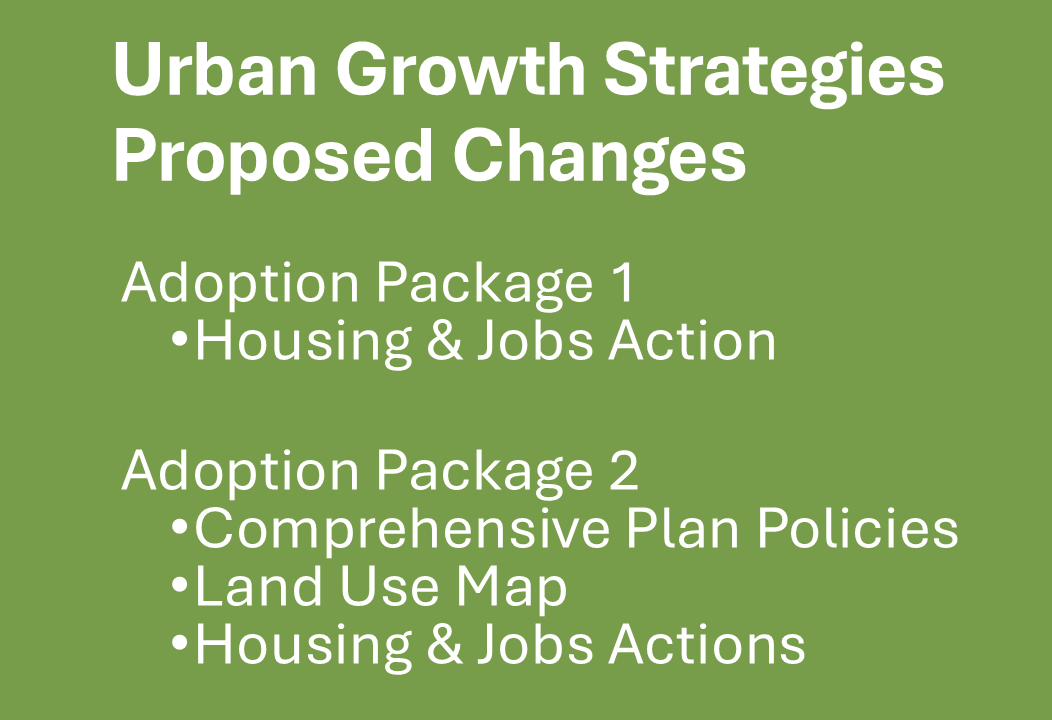
    The first package is primarily a series of legislative land use code amendments that are time-sensitive and are proposed both as actions to address some of the City’s housing and employment needs, as well as required responses to recent state legislation. Package #1 includes:

    Housing & Jobs Actions - Package #1

    The first local adoption process for Urban Growth Strategies has begun! This process includes work sessions, public hearings, a recommendation by the Planning Commission, and action by the City Council by the end of 2026.

    The first package is primarily a series of legislative land use code amendments that are time-sensitive and are proposed both as actions to address some of the City’s housing and employment needs, as well as required responses to recent state legislation. Package #1 includes:

    • Creating new development standards for micro village housing and single room occupancies (SROs) that would permit both housing types in all residential, commercial, and special area zones that allow housing.
    • Updates to middle housing development and land division standards, including changes to reduce the cost and complexity to develop middle housing, to improve clarity during plan review, to comply with recent changes to state law, and to align with the State‘s adopted Model Housing Code for Large Cities.
    • Additional changes to reduce barriers to housing and jobs development, including:
      • Allow adult and child day care centers and day care homes to be permitted in more zones.
      • Allow residential treatment facilities, residential treatment homes, and similar uses to be permitted outright in more zones.
      • Increase the maximum allowed building height in the R-1 Low-Density Residential Zone.
      • Streamline some residential land use application processes.
      • Provide temporary extensions of the expiration date of certain land use approvals.

    Review the proposed code amendments:


    A summary of all housing and jobs actions (including actions proposed for adoption both in 2026 and 2027) is available here (pdf).


    Below are some key dates, including opportunities to learn more about the proposed changes and then share your testimony with decisionmakers.

    Upcoming Public Hearing


    Online Info Sessions


    Past Work Sessions


    How to Submit Testimony


    Interested Parties List

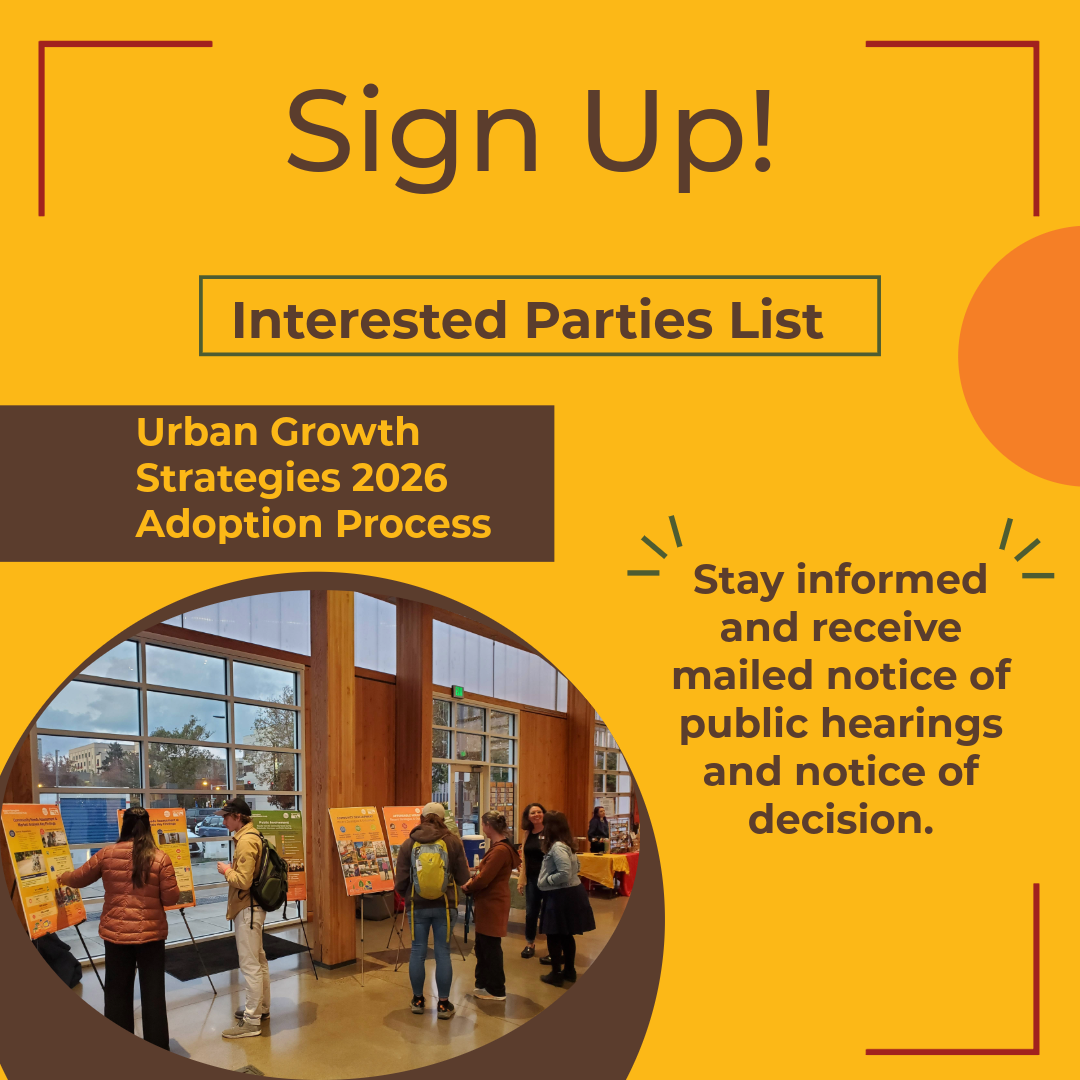
    If you are interested in receiving mailed notice for upcoming public hearings and the notice of decision, you can sign-up for the official interested parties list for the Urban Growth Strategies adoption process. First and last names, along with mailing addresses are needed, and may be made available to the public under Oregon Public Records Law. 

  • Public Meetings and Testimony

    Share Public Meetings and Testimony on Facebook Share Public Meetings and Testimony on X (formerly Twitter) Share Public Meetings and Testimony on Linkedin Email Public Meetings and Testimony link

    As a part of the Urban Growth Strategies adoption package #1, both the Eugene Planning Commission and the Eugene City Council will hold work sessions, public hearings, and deliberations. The City Council will be the final local decision-maker. Written and emailed testimony will be provided to decision makers in batches as it is received.

    Upcoming Public Hearing: Eugene Planning Commission

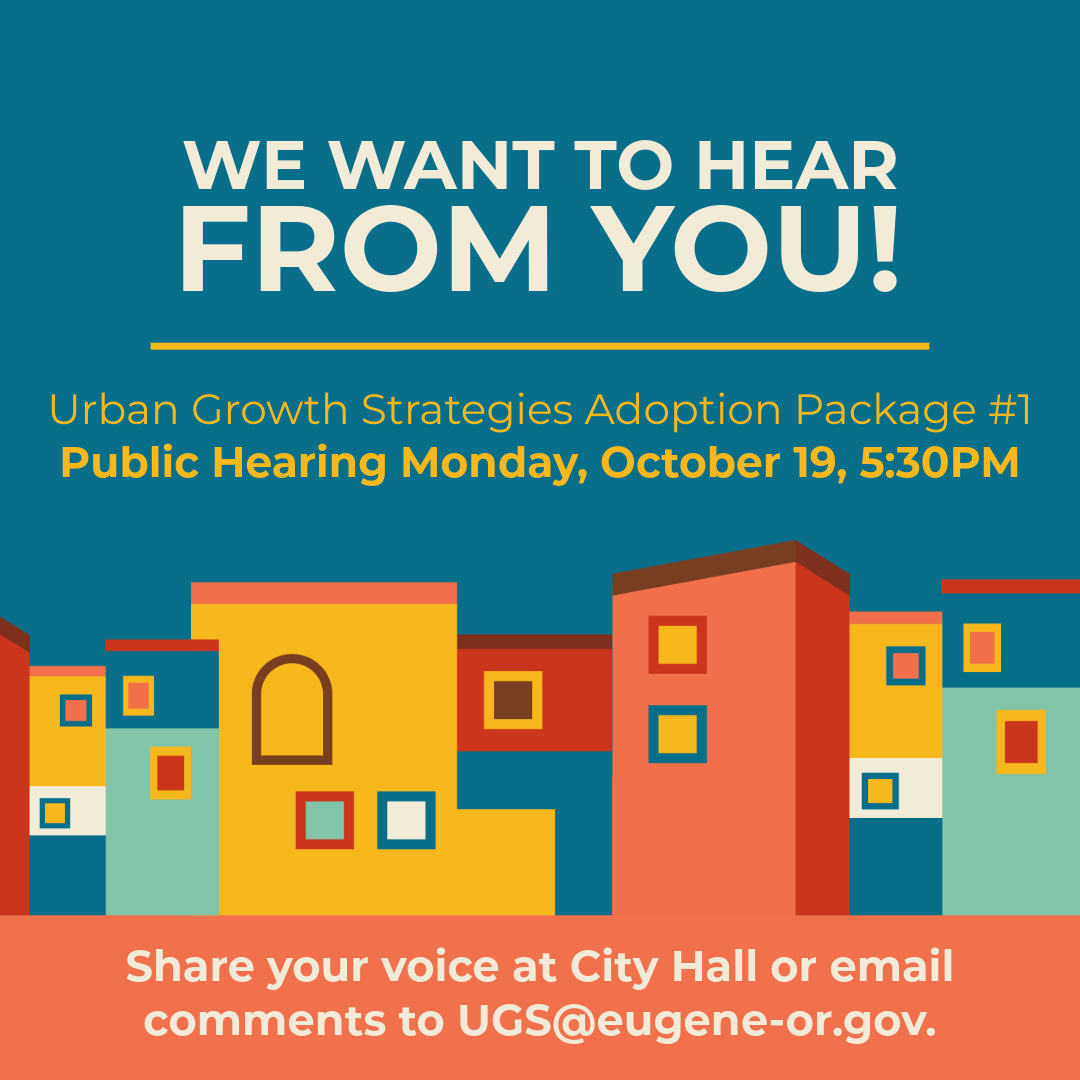
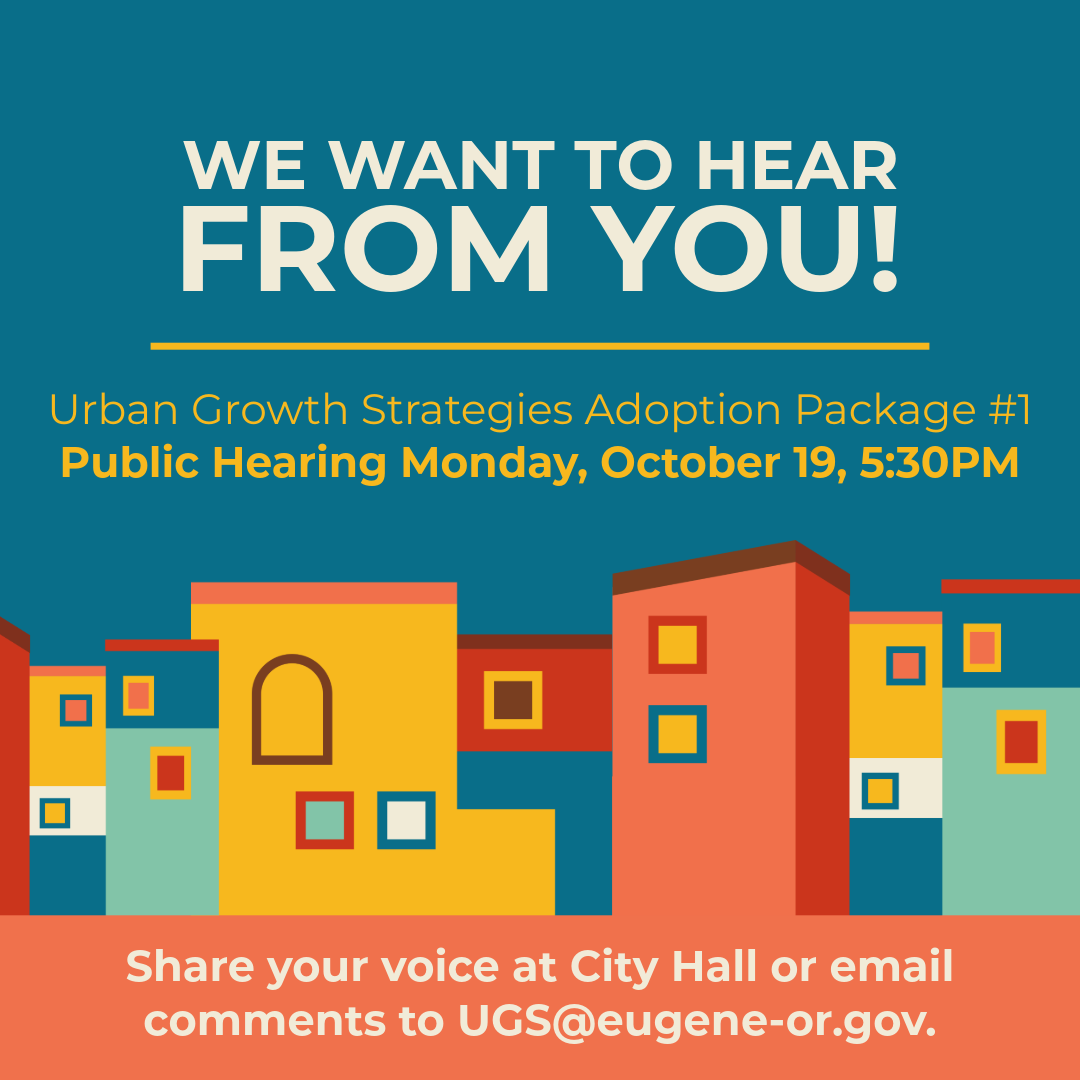
    The Eugene Planning Commission public hearing will be held virtually, Tuesday, June 23, 2026 at 5:30 p.m.

    Interested in more detail about the adoption package and process? Learn more in the summary of proposed citywide land use regulation amendments (pdf)

    As a part of the Urban Growth Strategies adoption package #1, both the Eugene Planning Commission and the Eugene City Council will hold work sessions, public hearings, and deliberations. The City Council will be the final local decision-maker. Written and emailed testimony will be provided to decision makers in batches as it is received.

    Upcoming Public Hearing: Eugene Planning Commission

    The Eugene Planning Commission public hearing will be held virtually, Tuesday, June 23, 2026 at 5:30 p.m.

    Interested in more detail about the adoption package and process? Learn more in the summary of proposed citywide land use regulation amendments (pdf). The public hearing materials, including the official proposed amendments, will be accessible online one week prior to the meeting (June 16, 2026).

    More information for options to attend, watch, and participate in the public hearing will be available at: Planning Commission Meetings webpage.


    To participate in the Public Hearing join using one of the two following options:

    • Join from a computer, tablet, or smart phone:

    Please use this URL to join: https://eugene-or-gov.zoom.us/j/86525188211

    Webinar ID: 865 2518 8211

    Sign up to speak by clicking once on the “raise hand” icon

    • Join by phone: Dial one of numbers below and enter the Webinar ID: 865 2518 8211

    +1 833-548-0276 (Toll Free); or

    +1 833-548-0282 (Toll Free); or

    +1 877-853-5257 (Toll Free)

    For higher quality, dial a number based on your current location.

    Sign up to speak by dialing *9 (Star-9)

    International numbers available: https://eugene-or-gov.zoom.us/u/kb2Du7X6gt


    How to Submit Testimony - Starting May 19th

    • Submit e-mail testimony to  UGS@eugene-or.gov
    • Submit a written statement to the Planning Commission, c/o Elena Domingo, City of Eugene Planning Division, 99 W. 10th Avenue, Eugene, Oregon 97401
  • Middle Housing and Micro Village Info Sessions

    Share Middle Housing and Micro Village Info Sessions on Facebook Share Middle Housing and Micro Village Info Sessions on X (formerly Twitter) Share Middle Housing and Micro Village Info Sessions on Linkedin Email Middle Housing and Micro Village Info Sessions link
    An infographic showing pencil drawn houses, a game board, and text that says "let's talk about housing"Want to learn more about upcoming changes to Middle Housing regulations? How about a new type of housing called Micro Village housing? City staff are inviting you to join them for a one-hour virtual information session on each topic to learn more about ways the City is supporting housing choice and affordability. These two topics are included in the upcoming Urban Growth Strategies adoption process.

    Each session will include a brief presentation and time to discuss questions.

    Recorded session: Micro Village Housing Information Session – May 27 at 5:30 p.m.

    Recorded session: Middle Housing Information Session - May

    An infographic showing pencil drawn houses, a game board, and text that says "let's talk about housing"Want to learn more about upcoming changes to Middle Housing regulations? How about a new type of housing called Micro Village housing? City staff are inviting you to join them for a one-hour virtual information session on each topic to learn more about ways the City is supporting housing choice and affordability. These two topics are included in the upcoming Urban Growth Strategies adoption process.

    Each session will include a brief presentation and time to discuss questions.

    Recorded session: Micro Village Housing Information Session – May 27 at 5:30 p.m.

    Recorded session: Middle Housing Information Session - May 20th at 12:00 p.m.


    Each session will be recorded and available for viewing after, but don’t miss out on this opportunity to talk with City of Eugene planners. Check out the Urban Growth Strategies webpage for more information on the project. If you have questions or need help joining the webinar, email Stuart Warren.

  • Adoption Process Preview

    Share Adoption Process Preview on Facebook Share Adoption Process Preview on X (formerly Twitter) Share Adoption Process Preview on Linkedin Email Adoption Process Preview link

    Urban Growth Strategies is set to begin the adoption process, when the Eugene City Council and Lane County Board of Commissioners will consider adoption of land use code and plan amendments.

    The proposed 2026 adoption package includes new chapters of the Envision Eugene Comprehensive Plan, a parcel-specific land use designation map, and changes to the land use code to support middle housing, diverse housing options, compact and walkable development, siting of daycare, and more.

    The adoption process will include public hearings and opportunities for verbal and written public testimony. If you are interested in receiving mailed notice for

    Urban Growth Strategies is set to begin the adoption process, when the Eugene City Council and Lane County Board of Commissioners will consider adoption of land use code and plan amendments.

    The proposed 2026 adoption package includes new chapters of the Envision Eugene Comprehensive Plan, a parcel-specific land use designation map, and changes to the land use code to support middle housing, diverse housing options, compact and walkable development, siting of daycare, and more.

    The adoption process will include public hearings and opportunities for verbal and written public testimony. If you are interested in receiving mailed notice for upcoming public hearings and the notice of decision, you can sign-up for the official interested parties list for the Urban Growth Strategies adoption process. First and last names, along with mailing addresses are needed, and may be made available to the public under Oregon Public Records Law.

  • March Project Update

    Share March Project Update on Facebook Share March Project Update on X (formerly Twitter) Share March Project Update on Linkedin Email March Project Update link

    Curious about what's going on with Urban Growth Strategies? Staff share regular updates that provide relevant project information, milestones, and upcoming opportunities for engagement. For March 2025, project updates include:

    • Urban Growth Strategies – Adoption Process Preview: Urban Growth Strategies project is set to begin the adoption process in Spring of 2026. Staff will ask the Eugene City Council to consider adoption of a package of land use code and plan amendments by the end of 2026.
    • Housing and Jobs Actions – Review Draft Concepts: As a part of Urban Growth Strategies, staff developed actions to meet the city’s

    Curious about what's going on with Urban Growth Strategies? Staff share regular updates that provide relevant project information, milestones, and upcoming opportunities for engagement. For March 2025, project updates include:

    • Urban Growth Strategies – Adoption Process Preview: Urban Growth Strategies project is set to begin the adoption process in Spring of 2026. Staff will ask the Eugene City Council to consider adoption of a package of land use code and plan amendments by the end of 2026.
    • Housing and Jobs Actions – Review Draft Concepts: As a part of Urban Growth Strategies, staff developed actions to meet the city’s housing, compact development, and jobs needs for the next 20 years.
    • Comprehensive Plan Updates: Staff shared five new draft chapters of the Comprehensive Plan with the Planning Commission. The next in the adoption process they will incorporate the Planning Commission’s feedback into hearings-ready draft chapters for the official adoption and public hearing process.
    • Advancing Racial Equity Through Housing Planning: The City of Eugene was selected to participate in a national community planning cohort supported by the Government Alliance on Race and Equity (GARE) and Race Forward; throughout 2026, the project team will receive technical and financial support to identify and prioritize actions that promote equitable growth.
    • Recent and Upcoming Public Meetings: If you missed any recent Urban Growth Strategies meetings, you can find an archive on the project webpage, and visit the City’s Public Meetings webpage for information on upcoming meetings.

    Read the full project update for March 2026 here.


  • Envision Eugene Comprehensive Plan Update

    Share Envision Eugene Comprehensive Plan Update on Facebook Share Envision Eugene Comprehensive Plan Update on X (formerly Twitter) Share Envision Eugene Comprehensive Plan Update on Linkedin Email Envision Eugene Comprehensive Plan Update link


    A view of downtown Eugene from above the Amazon PathA view of downtown Eugene from the Amazon Path


    On February 24, the Eugene Planning Commission will hold a work session on Phase II of the Envision Eugene Comprehensive Plan. The Comprehensive Plan guides the City in its land use planning for future growth within Eugene’s urban growth boundary. The first phase of the Comprehensive Plan was adopted in 2017. The second phase includes the following chapters:

    • Chapter 1 – Community Engagement
    • Chapter 2 – Compact Development & Urban Design
    • Chapter 4 – Housing
    • Chapter 5 – Community Health
    • Chapter 11 – Land Use (Including a new parcel-specific land use designation map)

    These new chapters are based on years of work and engagement with the community -- over the last two years City staff have engaged over 1,400 people on components of the Urban Growth Strategies Project, including the Comprehensive Plan. In late 2024 and early 2025, staff used this input to draft goals and policies for community review. Residents provided feedback through in-person events, digital surveys, a community advisory panel, and through the City’s boards and commissions. Over the past several months, staff have incorporated that feedback into the draft goals and policies. As a result, some policies have been removed, changed, added, or strengthened. To learn more about what staff heard from the community, check out the 2024 Community Engagement Summary (PDF) and the 2025 Community Engagement Summary (PDF).

    To learn more about Phase II of the Envision Eugene Comprehensive Plan and its development, tune in to the February 24 Planning Commission meeting or visit the project webpage. The Planning Commission welcomes input from the community and encourages community members to provide input during the Public Comment section of the agenda.

    Please email project staff (Stuart Warren: swarren@eugene-or.gov) with your questions, thoughts, and feedback.

    Next Steps

    During the February 24 Planning Commission meeting, staff will ask for the commission’s feedback on the updated draft chapters. Staff will then incorporate the Commission’s feedback in advance of the official adoption and public hearing process, which will begin in April 2026.


    A view of downtown Eugene from above the Amazon PathA view of downtown Eugene from the Amazon Path


    On February 24, the Eugene Planning Commission will hold a work session on Phase II of the Envision Eugene Comprehensive Plan. The Comprehensive Plan guides the City in its land use planning for future growth within Eugene’s urban growth boundary. The first phase of the Comprehensive Plan was adopted in 2017. The second phase includes the following chapters:

    • Chapter 1 – Community Engagement
    • Chapter 2 – Compact Development & Urban Design
    • Chapter 4 – Housing
    • Chapter 5 – Community Health
    • Chapter 11 – Land Use (Including a new parcel-specific land use designation map)

    These new chapters are based on years of work and engagement with the community -- over the last two years City staff have engaged over 1,400 people on components of the Urban Growth Strategies Project, including the Comprehensive Plan. In late 2024 and early 2025, staff used this input to draft goals and policies for community review. Residents provided feedback through in-person events, digital surveys, a community advisory panel, and through the City’s boards and commissions. Over the past several months, staff have incorporated that feedback into the draft goals and policies. As a result, some policies have been removed, changed, added, or strengthened. To learn more about what staff heard from the community, check out the 2024 Community Engagement Summary (PDF) and the 2025 Community Engagement Summary (PDF).

    To learn more about Phase II of the Envision Eugene Comprehensive Plan and its development, tune in to the February 24 Planning Commission meeting or visit the project webpage. The Planning Commission welcomes input from the community and encourages community members to provide input during the Public Comment section of the agenda.

    Please email project staff (Stuart Warren: swarren@eugene-or.gov) with your questions, thoughts, and feedback.

    Next Steps

    During the February 24 Planning Commission meeting, staff will ask for the commission’s feedback on the updated draft chapters. Staff will then incorporate the Commission’s feedback in advance of the official adoption and public hearing process, which will begin in April 2026.

  • Eugene's Equity Atlas Charts a Path Toward More Inclusive Planning

    Share Eugene's Equity Atlas Charts a Path Toward More Inclusive Planning on Facebook Share Eugene's Equity Atlas Charts a Path Toward More Inclusive Planning on X (formerly Twitter) Share Eugene's Equity Atlas Charts a Path Toward More Inclusive Planning on Linkedin Email Eugene's Equity Atlas Charts a Path Toward More Inclusive Planning link


    A black and white historic photo of Eugene taken from Skinner's Butte looking south down Willamette Street. It shows old buildings, farms, and mountains.Historic photo of Eugene looking south from Skinner’s Butte down Willamette Street


    The Planning Division is proud to announce the launch of its Equity Atlas: Selected Stories in Eugene’s History of Displacement—a research effort that documents how historic land use decisions have shaped today’s patterns of land use and housing access. Developed with funding from the Oregon Department of Land Conservation and Development, the Atlas responds to a statewide requirement for Oregon cities to pursue equity-informed planning. It draws from historical research and community input to share stories of how state and federal legislation, exclusionary zoning, and displacement have


    A black and white historic photo of Eugene taken from Skinner's Butte looking south down Willamette Street. It shows old buildings, farms, and mountains.Historic photo of Eugene looking south from Skinner’s Butte down Willamette Street


    The Planning Division is proud to announce the launch of its Equity Atlas: Selected Stories in Eugene’s History of Displacement—a research effort that documents how historic land use decisions have shaped today’s patterns of land use and housing access. Developed with funding from the Oregon Department of Land Conservation and Development, the Atlas responds to a statewide requirement for Oregon cities to pursue equity-informed planning. It draws from historical research and community input to share stories of how state and federal legislation, exclusionary zoning, and displacement have impacted Eugene’s marginalized communities over time.

    The Equity Atlas is meant to serve as more than just a historical record—it’s the beginning of a process to understand past harms and inform more equitable planning practices and policies moving forward through the Urban Growth Strategies project. At the August 12, 2025 Planning Commission meeting, commissioners affirmed this research as a foundational tool for shaping Eugene’s Contextualized Housing Need, Housing Capacity Analysis, and Housing Production Strategy. These planning efforts will guide how and where Eugene grows, ensuring that future land use decisions address past harms and promote more equitable outcomes. This research is also being integrated into the Envision Eugene Comprehensive Plan, embedding equity into the city’s long-range vision for housing, land use, and community well-being.

    Explore the Equity Atlas StoryMap to learn how Eugene’s past is informing a more equitable future.
  • October 2025 Project Update

    Share October 2025 Project Update on Facebook Share October 2025 Project Update on X (formerly Twitter) Share October 2025 Project Update on Linkedin Email October 2025 Project Update link

    Curious about what's going on with Urban Growth Strategies? Staff share regular updates that provide relevant project information, milestones, and upcoming opportunities for engagement. For October 2025, project updates include:

    • Eugene's Equity Atlas Charts a Path Toward More Inclusive Planning: The Planning Division is proud to announce the launch of its Equity Atlas: Selected Stories in Eugene’s History of Displacement—a research effort that documents how historic land use decisions have shaped today’s patterns of land use and housing access.
    • Eugene's Comprehensive Plan Update: Using the feedback staff heard from the community, staff are refining the draft goals and policies

    Curious about what's going on with Urban Growth Strategies? Staff share regular updates that provide relevant project information, milestones, and upcoming opportunities for engagement. For October 2025, project updates include:

    • Eugene's Equity Atlas Charts a Path Toward More Inclusive Planning: The Planning Division is proud to announce the launch of its Equity Atlas: Selected Stories in Eugene’s History of Displacement—a research effort that documents how historic land use decisions have shaped today’s patterns of land use and housing access.
    • Eugene's Comprehensive Plan Update: Using the feedback staff heard from the community, staff are refining the draft goals and policies, as appropriate. In 2026, staff will be asking the Eugene City Council and Lane County Board of Commissioners to consider adopting the new chapters.
    • Draft Eugene Centers and Key Corridors Map: As a result of community input and staff research, the Planning Division has created a draft Centers and Key Corridors map and policies for the Comprehensive Plan.
    • Community Input on Housing Actions: To help meet Eugene’s 20-year housing and jobs needs, City staff have proposed a series of housing, compact development, and jobs actions as priorities for City Council adoption in 2026 and 2027. To inform these actions, staff have engaged with housing developers as well as a Community Advisory Panel supporting Urban Growth Strategies.
    • 2025 Community Engagement Summary: The 2025 Community Engagement Summary provides an overview of the engagement activities and key takeaways from the past year of community engagement. Staff continued to hear about housing affordability and availability, desired neighborhood qualities, and support for working towards a more equitable future.
    • Recent and Upcoming Public Meetings: City Staff will be providing updates on the Urban Growth Strategies project to the Planning Commission on October 28th, 2025, and City Council on November 12, 2025. Then, on November 24, 2025, Planning Division staff will ask the City Council to initiate land use code and plan amendments for Urban Growth Strategies.


    Read the full project update for October 2025 here.

Page last updated: 10 Aug 2026, 05:06 PM