
Polk Street Bike Lanes
Consultation has concluded
June 2026 Update
Polk Street Project Decision
Transportation Planning staff met with the City Engineer to discuss recommendations for Polk Streets. Staff consider many factors, including community input, City goals, established best practices, operational needs, and budget, when making project recommendations.
The City has decided to move forward with the following recommendations for Polk Street.
Install buffered bike lanes and remove on-street parking on Polk Street from 18th Avenue to the alleyway between 6th and 5th Avenues.
On-street parking will remain on Polk Street between 2nd Avenue and 5th Avenue Alley.
Repair areas of poor pavement along Polk Street between 2nd Avenue and 18th Avenue.
Make minor improvements to the Fern Ridge Path crossing of Polk Street by adding signage, striping, street lighting, and potentially removing vegetation to improve sight lines.
Add neighborhood greenway elements to Polk Street between 2nd Avenue and 5th Avenue Alley, potentially including but not limited to sharrows, signage, speed cushions, and traffic circles.
Add parking bays to select areas on Polk Street between 7th Avenue and 18th Avenue as budget allows.
Polk Street Community Meeting
Learn more about upcoming changes to Polk Street at a community meeting.
- Tuesday, July 14th
- 6:00pm - 7:00pm
- The Faith Center (1410 13th Avenue)
The City is holding a community meeting to share what was heard during community engagement, preview the planned design, and lay out next steps for the project.
Next Steps
The project will move from the planning phase into the engineering phase where project elements will continue to be refined. Simultaneously, City staff will work through the administrative process to remove on-street parking. Construction is planned for spring or summer 2027.
May 2026 Update
Polk Street Engagement Report
City staff have completed the Polk Street Engagement Report. The report summarizes engagement activities and input received as part of the Polk Street Bike Lanes planning process. Engagement began in late 2025 and concluded in March 2026. The report outlines what staff heard from the community as well as internal City departments and staff. Engagement is an essential part of the project lifecycle. What staff learn through engagement often influences the design of a project as well as its path to construction. Staff consider many factors, including community input, City goals, established best practices, operational needs, and budget, when making project decisions.
Polk Street Traffic Analysis Report
The Polk Street Traffic Analysis Report is now available. Currently, Polk Street has dedicated vehicle turn lanes at intersections with traffic signals (6th, 7th, 11th, 13th, and 18th Avenues). Continuing bike lanes through these intersections would require removing dedicated turn lanes. Transportation Planning staff contracted with the consulting firm DKS to better understand how removal of turn lanes would impact each intersection’s level of service (i.e. the average delay experienced by vehicles at the intersection). DKS analyzed the five intersections with traffic signals along Polk Street and found that removal of turn lanes would minimally impact overall intersection level of service.
Next Steps
Transportation Planning staff have developed a recommendation for Polk Street. The recommendation has been sent to the Transportation Planning Team Manager for review and input. From there, the recommendation will be shared with the City Engineer for decision making purposes. The City Engineer may choose to involve the Interim Public Works Director and City Manager in the decision-making process. Transportation Planning staff will organize another community meeting to share the decision about the design of Polk Street when a decision has been made.
March 2026 Update
City staff have completed the Polk Street On-Street Parking Report. The report outlines the current parking use along Polk Street and side streets. Understanding parking use is an important part of the planning process when parking removal is being proposed. Parking counts help answer questions like: Where and when is parking most used? How does parking use vary along a street? Can side streets accommodate additional parking demand?
Staff found that on-street parking use along Polk Street varies block by block; some blocks average over eight parked cars while other blocks average less than one parked car. The average number of cars parked on Polk Street between 2nd Avenue and 18th Avenue is 60.8, filling about 25% of available on-street parking spaces. The Parking Report is available under the "Documents" tab on the right side of this page.
February 2026 Update
The second Polk Street community meeting was held on Tuesday, March 3rd, 2026, at the Faith Center (1410 W 13th Avenue). This meeting presented the same content as the January 21st meeting.
January 2026 Update
The first Polk Street community meetings was held on Wednesday, January 21st, 2026, at the Faith Center (1410 W 13th Avenue). City staff gave a short presentation followed by time for community members to discuss the project. Staff collected comments and questions from the meeting and have assembled a Q&A document. The Q&A document and a PDF version of the meeting's presentation are available under the "Documents" tab on the right side of this page.
Project Overview
The City of Eugene identified Polk Street from 2nd Avenue to 18th Avenue for bike lanes through a community-driven process called Move EUG in 2023. Bike lanes on Polk Street also were identified in the Transportation System Plan, adopted in 2017.
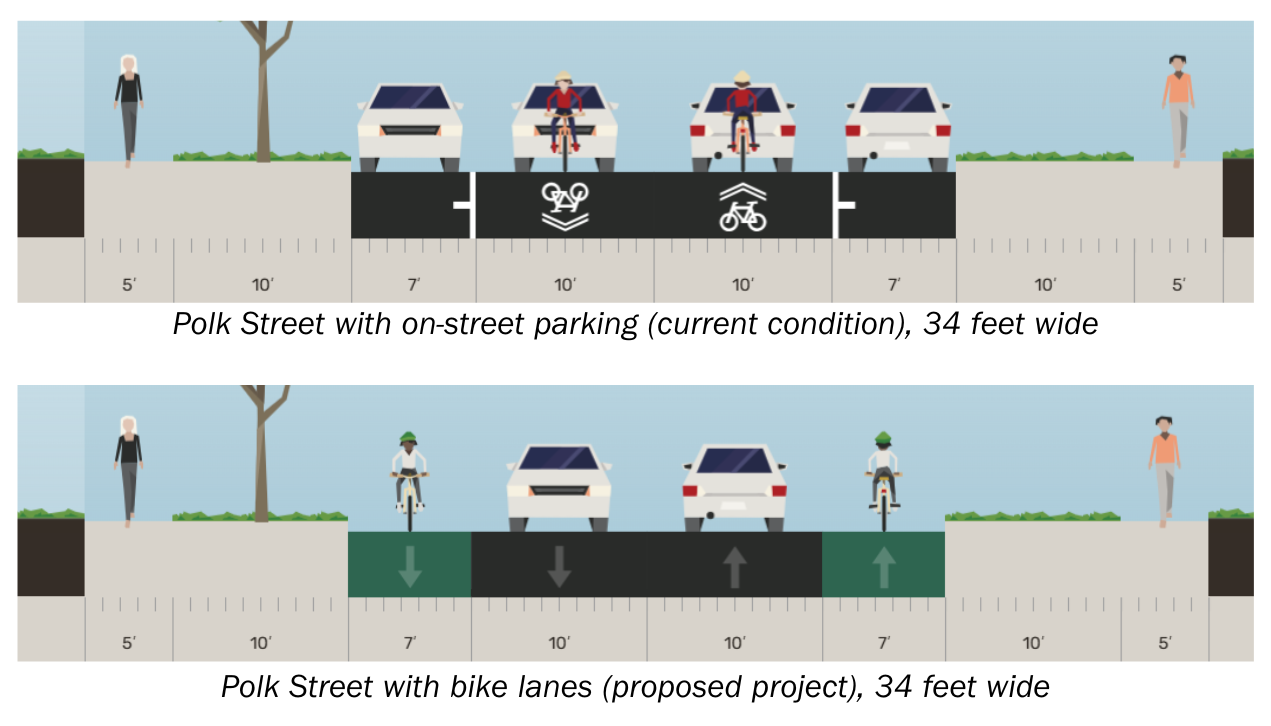
Polk Street is an important bicycle route that does not provide dedicated space for people biking. Currently, Polk Street has two vehicle travel lanes and on-street parking on both sides of the street. Adding bike lanes to Polk Street would likely require removing some or all of the on-street parking. The graphic below shows how space is allocated on Polk Street today (current condition) and how space could be allocated if bike lanes are added (proposed project).
Community Engagement
Funding to add bike lanes on Polk Street comes from the voter approved 2022 Street Repair Bond Measure. While funding has been set aside, the City has not made final decisions about adding bike lanes or changing the street design.
Hearing from community members is a vital part of the planning process. In late 2025 and early 2026, residents were invited to attend community meetings, take a project survey and share input and feedback about the proposed bike lanes with City staff.
The City is reviewing community feedback and input and expects share a decision about Polk Street in late spring 2026. Community input, along with city goals, established best practices, operational needs, and budget will all help shape the final design of Polk Street.
Reasons for the Proposed Change
Polk Street is an important route for people travelling north and south between the Whiteaker and Friendly neighborhoods. Polk Street is one of the few streets that runs from 2nd Avenue to 28th Avenue and serves as an alternate route to Chambers Street.
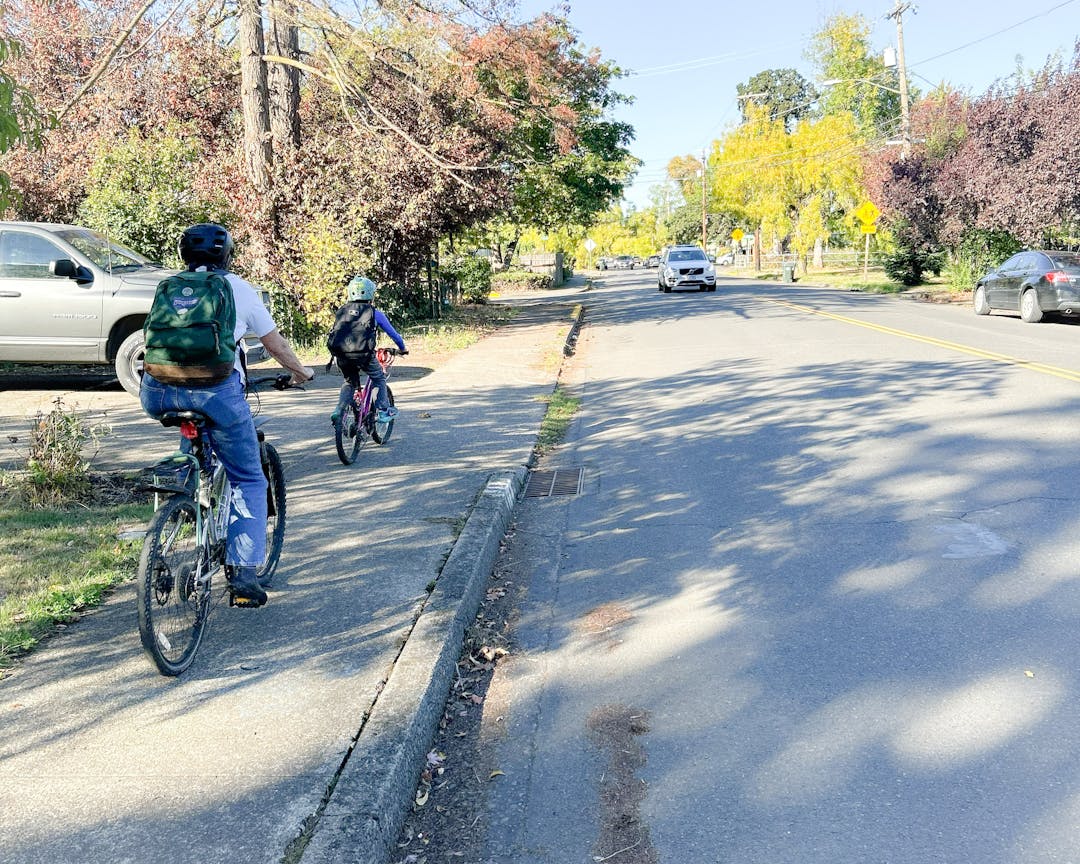
Observation of Polk Street shows people biking, including with children, weaving in and out of the on-street parking lane, riding with traffic and being aggressively passed by people driving, lane splitting between parked cars and stopped traffic, biking on the sidewalk and other unsafe behaviors by both people driving and people biking. The speed and volume of vehicles that use Polk Street, the behavior of people driving and biking, and Polk Street's connectivity make the street an important candidate for dedicated bike lanes.
